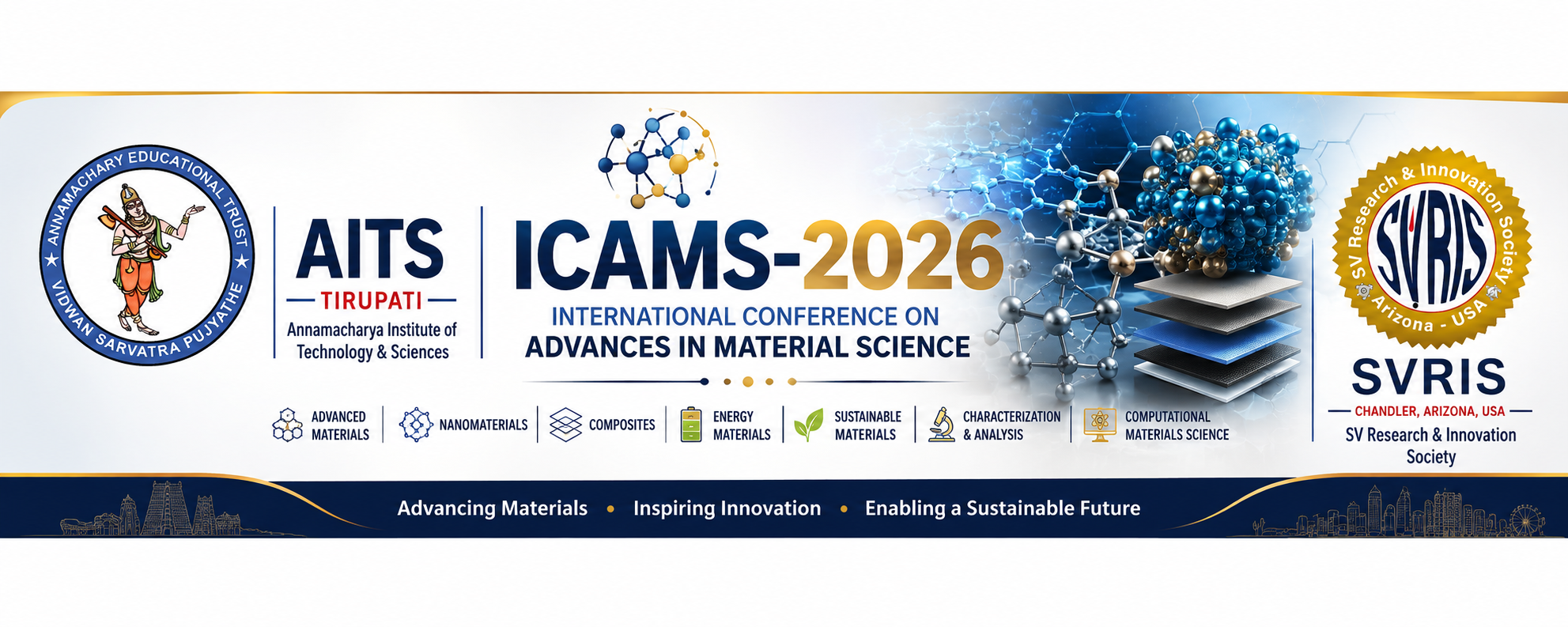
International Conference on Advances in Material Science-2026

Call for paper
Call for Papers: ICAMS-2026
The International Conference on Advances in Material Science (ICAMS-2026) invites researchers, academicians, scientists, industry professionals, engineers, and research scholars to submit original and high-quality research contributions in the broad area of materials science and engineering. The conference provides an interdisciplinary platform for presenting recent advances in advanced materials, nanomaterials, composites, energy materials, sustainable materials, material characterization, computational materials science, manufacturing, and emerging material technologies.
Track 1: Advanced and Functional Materials
- Advanced engineering materials and multifunctional materials.
- Smart, adaptive, responsive, and functional materials.
- High-temperature, high-strength, and lightweight materials.
- Metallic, ceramic, polymeric, and hybrid material systems.
- Shape-memory, piezoelectric, magnetic, and dielectric materials.
- Surface engineering, coatings, thin films, and protective materials.
Track 2: Nanomaterials and Nanotechnology
- Synthesis, processing, and characterization of nanomaterials.
- Nanoparticles, nanocomposites, nanostructures, and quantum materials.
- Graphene, carbon nanotubes, and two-dimensional materials.
- Nanoelectronics, nanosensors, and functional nanodevices.
- Nanomaterials for biomedical, environmental, and energy applications.
- Computational modeling and simulation of nanoscale materials.
Track 3: Composite and Hybrid Materials
- Polymer, metal, and ceramic matrix composites.
- Fiber-reinforced and particulate-reinforced composites.
- Natural-fiber, bio-based, and green composites.
- Hybrid composites and multifunctional composite structures.
- Mechanical behavior, damage, fatigue, fracture, and durability of composites.
- Composite manufacturing, joining, machining, and performance optimization.
Track 4: Energy Materials and Storage Technologies
- Materials for batteries, supercapacitors, and energy-storage systems.
- Solar-cell, photovoltaic, and photoelectrochemical materials.
- Fuel-cell, hydrogen-storage, and hydrogen-production materials.
- Thermoelectric, piezoelectric, and energy-harvesting materials.
- Electrode, electrolyte, and catalytic materials.
- Materials for renewable and clean-energy technologies.
Track 5: Sustainable, Green, and Bio-Based Materials
- Sustainable materials processing and green manufacturing.
- Recycled, waste-derived, and circular-economy materials.
- Biodegradable polymers, biomaterials, and bio-inspired materials.
- Eco-friendly construction and infrastructure materials.
- Life-cycle assessment and environmental impact of materials.
- Low-carbon and resource-efficient material technologies.
Track 6: Material Characterization and Performance Analysis
- Microstructural, morphological, thermal, and spectroscopic characterization.
- Mechanical, electrical, optical, magnetic, and tribological properties.
- Corrosion, wear, fatigue, creep, fracture, and failure analysis.
- Non-destructive testing and advanced microscopy techniques.
- Structure-property-processing relationships in materials.
- Reliability, durability, and performance assessment.
Track 7: Computational Materials Science and Artificial Intelligence
- Computational modeling, simulation, and multiscale materials analysis.
- Machine learning and artificial intelligence for materials discovery.
- Data-driven prediction of material properties and performance.
- Materials informatics and high-throughput materials screening.
- Molecular dynamics, density functional theory, and finite-element modeling.
- Digital twins and optimization of material-processing systems.
Track 8: Manufacturing, Processing, and Emerging Material Technologies
- Additive manufacturing and 3D/4D printing of materials.
- Advanced casting, forming, welding, machining, and joining technologies.
- Powder metallurgy, sintering, and advanced processing methods.
- Laser, plasma, and surface-modification technologies.
- Industry 4.0 and intelligent manufacturing for materials processing.
- Emerging materials and processing technologies for future engineering applications.
Track 9: Materials for Engineering, Biomedical, Aerospace, and Environmental Applications
- Materials for civil, mechanical, electrical, electronic, and structural engineering.
- Biomaterials, implants, tissue-engineering materials, and biomedical coatings.
- Lightweight and high-performance materials for aerospace and automotive applications.
- Materials for sensors, electronics, photonics, and communication systems.
- Adsorbents, membranes, catalysts, and materials for environmental remediation.
- Emerging interdisciplinary applications of advanced materials.
ICAMS-2026 welcomes original research papers, review-oriented contributions, experimental studies, computational investigations, case studies, and industry-oriented research addressing advances in material science and related interdisciplinary applications. Authors are encouraged to submit novel work that contributes to the development of high-performance, sustainable, intelligent, and next-generation materials.